
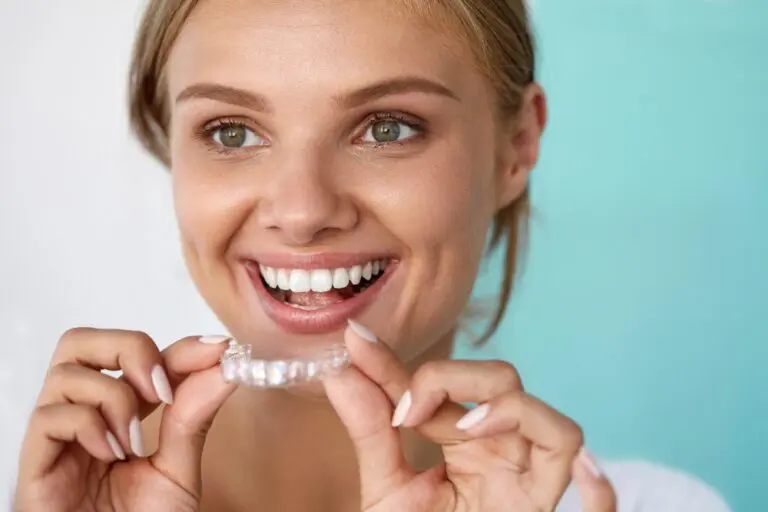
The clear tray gets most of the attention, but the real engineering breakthrough behind what modern Invisalign can treat is the attachment system: small, tooth-colored shapes bonded to specific teeth that give a smooth tray something to grip. Without them, a plastic tray can push and tip teeth reasonably well, but it has real limits on more complex movements like rotation, which is exactly the gap attachments were engineered to close.
If you’re asking how does Invisalign work in Prosper, TX: a 3D scan plans your treatment in advance, then a series of custom clear trays applies gentle, staged pressure to move your teeth, with small tooth-colored attachments added to specific teeth to help the tray grip movements a smooth tray alone can’t achieve as reliably. Attachments, not just the trays themselves, are a big part of why Invisalign can now handle a much wider range of cases than it could in its earlier years.

Why a Smooth Tray Alone Has Real Limits
A tooth’s natural surface is smooth and rounded, which gives a plastic tray a reasonably good grip for pushing a tooth in one direction or tipping it at an angle. Rotation is a harder problem. Twisting a tooth around its own axis requires force applied at specific points around the tooth’s circumference, and a smooth surface doesn’t give a tray much to grab onto for that kind of movement. The same is true for more precise vertical movements, pulling a tooth further out of the bone or pushing it further in.
This is the actual physics behind why early aligner systems struggled with certain cases that braces handled more reliably. It wasn’t a shortcoming of the material or the digital planning behind it; it was a genuine mechanical limitation of a smooth tray trying to grip a smooth tooth.
How Attachments Solve Specific Movement Problems
Attachments are small, precisely shaped composite bumps bonded to specific teeth in specific positions, each designed to interact with the tray in a particular way. A rectangular attachment placed at a specific angle gives the tray a defined edge to push against for rotation. A different shape positioned near the gumline can help the tray engage a tooth for the kind of vertical movement that a smooth surface alone doesn’t support well.
This is why two patients with different specific movements needed can have very different attachment patterns even within a similar overall treatment plan. The attachments aren’t decorative or interchangeable; each one is placed to solve a specific mechanical problem for a specific tooth.
Why Complex Cases Need More Attachment Planning, Not Just More Trays
Deciding where attachments go, what shape each one needs to be, and how they work together across a full arch is a more specialized part of digital treatment planning than simply mapping tooth positions from start to finish. Dr. Mo Al-Zainal completed a residency with research on BRIUS, an advanced lingual bracket system, and an additional Aligner Intensive Fellowship focused specifically on planning complex cases with trays. That combination of training is directly relevant to attachment planning specifically, since getting attachment placement right for a difficult rotation or a bite correction is a more technical exercise than adding more trays to a sequence.
This is part of why two orthodontists can look at the same complex case and reach different conclusions about whether Invisalign is a good fit. The difference often comes down to how confidently attachment placement can be planned for that specific case, not just an overall impression of severity.
Can Attachments Be Hidden?
For patients concerned about attachment visibility, placing attachments on the tongue side of the teeth, rather than the front, is an option for some movements. This is where Dr. Al-Zainal’s background in BRIUS, a lingual bracket system placed entirely behind the teeth, connects directly to aligner planning: that same experience working from behind the teeth informs how tongue-side attachment placement gets planned into an aligner case.
This approach doesn’t work for every movement. Some tooth movements respond reliably to a tongue-side attachment, while others still need the attachment on the front surface to give the tray adequate grip, so a treatment plan sometimes mixes hidden and visible placement depending on what each specific tooth needs to move correctly. Tooth anatomy matters too: a tooth with a narrower surface on the tongue side may not leave enough room for an attachment to sit securely there, in which case front-side placement remains the more reliable choice for that tooth.
Where tongue-side placement is a workable option for the movement involved, the goal is to keep as many attachments out of view as possible, while still prioritizing whichever placement gives the most reliable grip for that tooth’s specific movement.
How the Digital Planning Ties It Together
A 3D scan of your teeth and bite feeds into software that maps your entire treatment in advance, including where attachments need to go and which stage of the tray sequence they support. Each tray is then manufactured to work with that plan, applying gentle, staged pressure while attachments handle the movements a smooth tray surface can’t grip as reliably on its own.
Dr. Adam Reynolds, an orthodontist at Orthodontic Design Co. in Madison, AL, notes that this kind of planned, gradual movement is powerful enough to guide even difficult teeth into position when the underlying mechanics, trays and attachments together, are set up correctly for that specific case.
Living With Invisalign
Trays come out for eating and drinking anything but water, and cleaning them with a soft brush and cool water (never hot, which can warp the plastic) keeps them clear. Wearing them 20 to 22 hours daily is what keeps the plan, attachments included, progressing on schedule.
Monitoring Your Progress
Visits every 6 to 10 weeks confirm that your teeth, and specifically the movements attachments are designed to support, are tracking with the original plan. If something isn’t moving as expected, adjustments, sometimes including new attachments or a refinement scan, keep the case on track rather than continuing the original sequence unchanged.
Frequently Asked Questions
Do all Invisalign patients need attachments?
No. Simple cases involving mainly tipping or spacing often need few or no attachments. Attachments become more central to the plan as a case involves more rotation, extrusion, or other movements a smooth tray alone handles less reliably.
Can attachments be seen by other people?
They’re made of tooth-colored composite and are generally subtle, though they can be somewhat noticeable up close depending on placement. Most patients find them far less noticeable than traditional braces brackets.
Can attachments be placed so they’re not visible at all?
For some movements and tooth shapes, yes. Attachments can sometimes be placed on the tongue side of the tooth instead of the front, keeping them out of view. This isn’t possible for every movement or every tooth, since tongue-side surface width and the specific mechanical needs of a given movement both play a role, so a plan sometimes combines hidden and visible attachments to make sure each tooth gets the placement it actually needs.
Why did my orthodontist recommend more attachments than a friend’s plan had?
This usually reflects the specific movements your case needs. More complex rotations or bite corrections typically require more attachments to give the tray adequate grip for those movements, not a difference in how “difficult” your case is overall.
What happens if an attachment falls off during treatment?
Contact your orthodontist. Depending on where you are in your treatment, it may need to be rebonded to keep your specific movements on track, since attachments are placed to solve particular mechanical needs in your plan.
Sources. General principles of clear aligner biomechanics regarding attachment-assisted tooth movement; clinical and administrative observations from Wink Orthodontics, Prosper and Colleyville, TX.
Related Reading
Can Invisalign Fix Overbite in Prosper and Colleyville, TX
Get an Attachment Plan Built for Your Specific Case
Wink Orthodontics uses specialized digital planning to determine exactly where attachments are needed for your specific movements, not a one-size-fits-all approach.
Free consultation for new patients.